

The 5 Stages of Language Acquisition: A Guide for Teachers
Krashen's research-backed model gives teachers a roadmap from silent comprehension to academic fluency, with the scaffolds that fit each stage.




The five stages of language acquisition give teachers a research-backed roadmap for English learners. Linguist Stephen Krashen's framework preproduction, early production, speech emergence, intermediate fluency, and advanced fluency describes how students move from silent comprehension to academic mastery, and roughly how long each step takes. Knowing where a student sits on the model changes everything about how you scaffold their day.
What Are the 5 Stages of Language Acquisition?
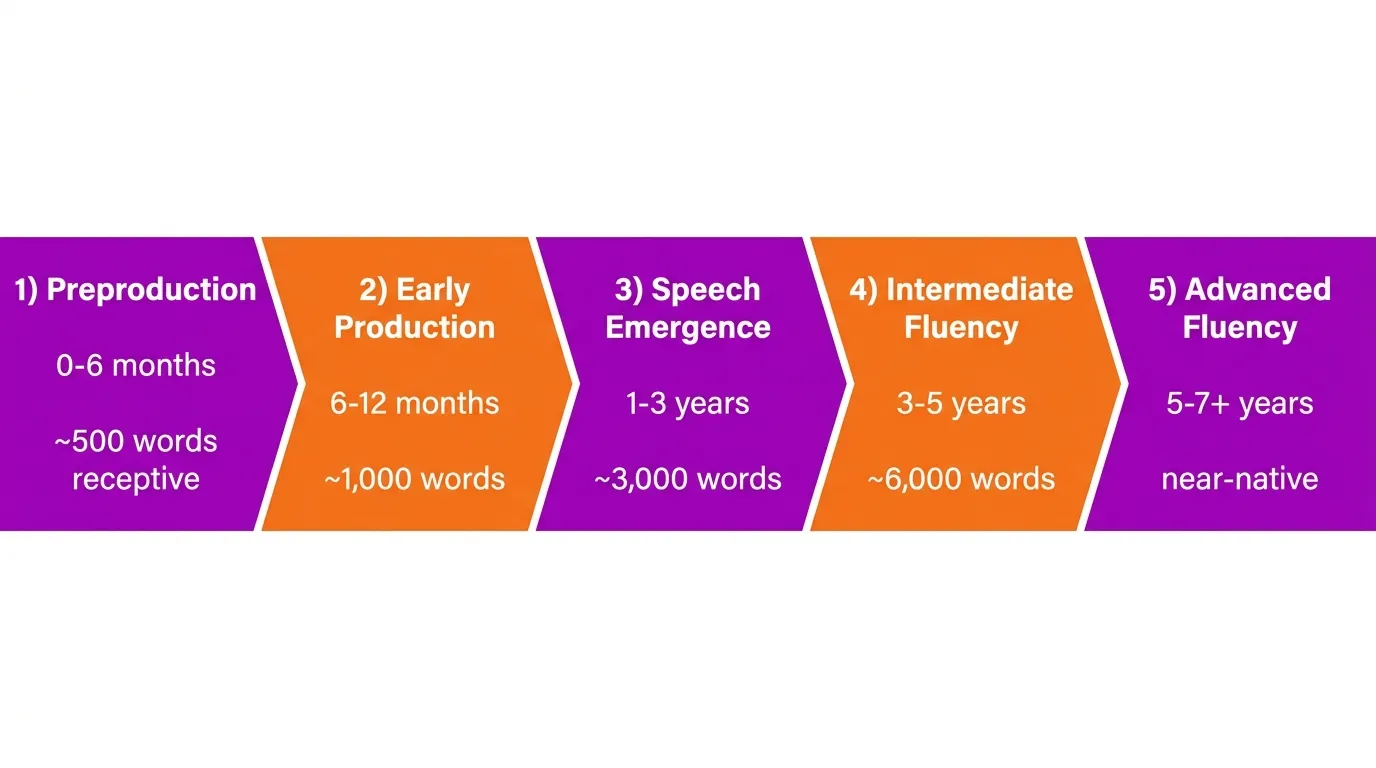
The five stages of language acquisition are preproduction, early production, speech emergence, intermediate fluency, and advanced fluency. Developed by linguist Stephen Krashen, the model describes the predictable progression English learners follow from silent comprehension to academic-level proficiency, typically over five to seven years.
The stages map closely to the WIDA Can-Do Descriptors, the framework used in 41 U.S. states to guide ELL instruction. Per the U.S. Department of Education's NCELA, more than five million students are classified as English learners in U.S. public schools, so getting this right has scale.
- Preproduction: 0 to 6 months, silent receptive learning
- Early Production: 6 to 12 months, one to two-word responses
- Speech Emergence: 1 to 3 years, simple sentences
- Intermediate Fluency: 3 to 5 years, complex sentences and opinions
- Advanced Fluency: 5 to 7+ years, near-native academic English
For the wider context on planning instruction across the year, see our ELL teaching pillar.
Stage 1: Preproduction (Silent Period)
Preproduction, also called the silent period, is when students absorb language without producing it. They build a receptive vocabulary of up to 500 words and respond nonverbally by pointing, nodding, or drawing. The stage can last from a few hours to several months and should not be forced.
Classroom strategies
- Yes/no and one-word identification questions
- Visuals, gestures, and total physical response (TPR)
- Wait time; do not push spoken output
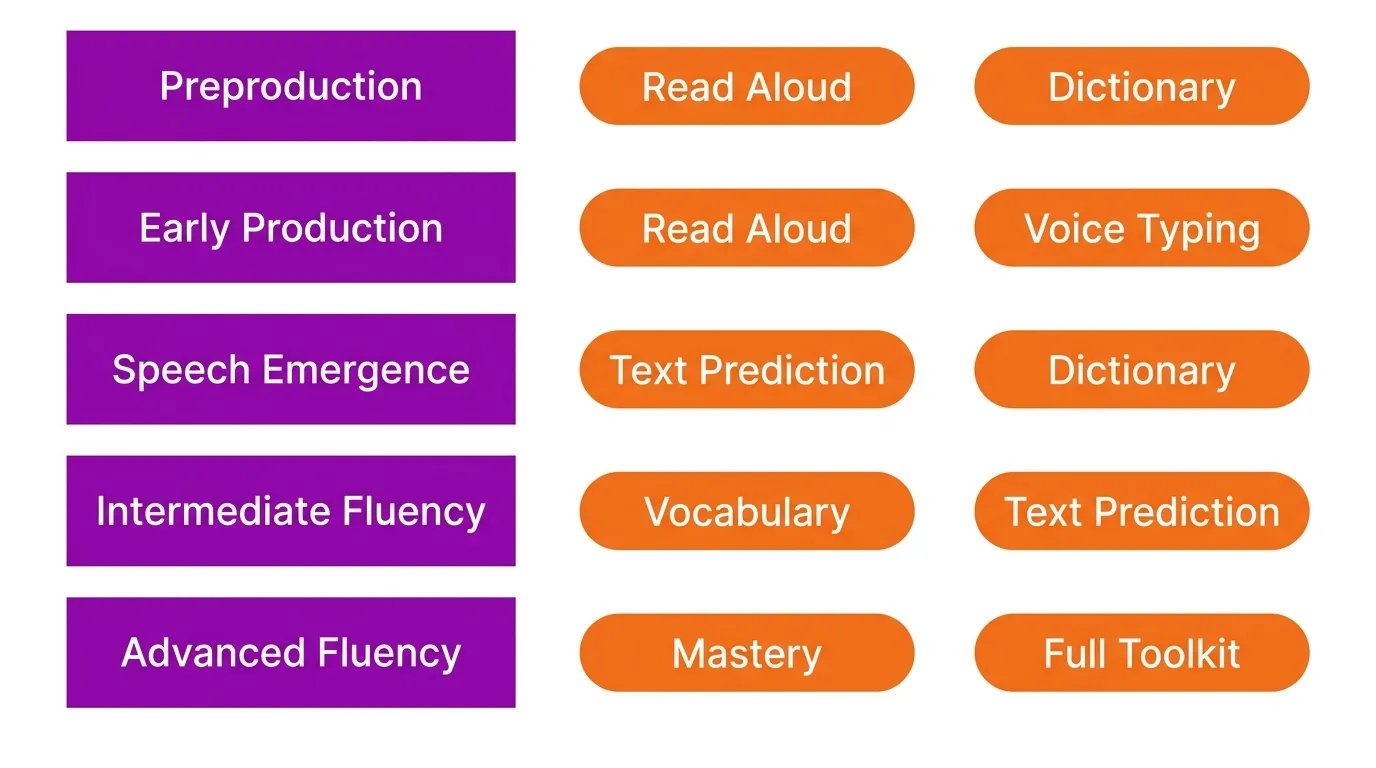
Mote tools that fit Stage 1
- Read Aloud: students hear English text at their own pace without having to speak
- Dictionary: instant definitions feed receptive vocabulary growth
Stage 2: Early Production
Early Production is when students start producing one or two-word responses, with a vocabulary of around 1,000 words. The stage typically lasts about six months. Learners can answer simple yes/no or either/or questions but still rely heavily on context.
Classroom strategies
- Cloze (fill-in-the-blank) activities and sentence frames
- Word banks tied to the lesson's content vocabulary
- Pair work with peers who share the home language
Mote tools that fit Stage 2
- Read Aloud: keeps comprehensible input flowing as production starts
- Speech to Text: a low-pressure way to attempt spoken English inside writing tasks
Stage 3: Speech Emergence
Speech Emergence is when students begin using simple sentences and asking their own questions, with a working vocabulary of around 3,000 words. The stage often lasts a year or more and looks more confident than it is. Students still need significant scaffolding for grade-level academic content.
Classroom strategies
- Open-ended questions paired with sentence stems
- Modelled writing and shared reading routines
- Front-load academic vocabulary before content lessons
Mote tools that fit Stage 3
- Text Prediction: bridges the gap between spoken fluency and written accuracy
- Dictionary: handles new academic vocabulary in real time
Stage 4: Intermediate Fluency
Intermediate Fluency is when students use more complex sentences, share opinions, and approach a 6,000-word vocabulary. The stage can last several years. It is also where the gap between BICS (social language) and CALP (academic language) becomes most visible, and where ELLs are most often misidentified as needing special education.
Classroom strategies
- Structured academic discussions with assigned roles
- Explicit instruction in content-specific vocabulary
- Writing across disciplines with feedback cycles
Mote tools that fit Stage 4
- Vocabulary: capture and revisit subject-specific words across classes
- Text Prediction: supports more sophisticated written expression
Stage 5: Advanced Fluency
Advanced Fluency is near-native proficiency in both social and academic English. Students can understand and produce content across grade-level subjects, though idiomatic or culturally embedded language may still trip them up. Reaching this stage typically takes five to seven years of consistent, well-scaffolded instruction.
Classroom strategies
- Full grade-level participation with light scaffolds
- Self-monitoring and peer-editing routines
- Continued exposure to varied genres and registers
Mote tools that fit Stage 5
- Mastery: spaced practice for refining academic vocabulary
- Full Mote toolkit: students self-select supports as needed
Stage-Aware Teaching Beats Generic Accommodation
Stage-aware teaching is what turns ELL support from generic accommodation into precise scaffolding. Treat preproduction silence as growth, not absence. Match your tools to the stage, not the grade. Mote runs inside Google Workspace, so the scaffold a student needs in Stage 2 travels with them into Stage 5, and quietly scales back as they no longer need it. That is the difference between an ELL program that compounds and one that just complies.