English Language Learners with Mote
Mote pairs Read Aloud, Text Prediction, and an in-context Dictionary with multilingual support to help English language learners access grade-level content, build academic vocabulary, and produce confident written and spoken English.
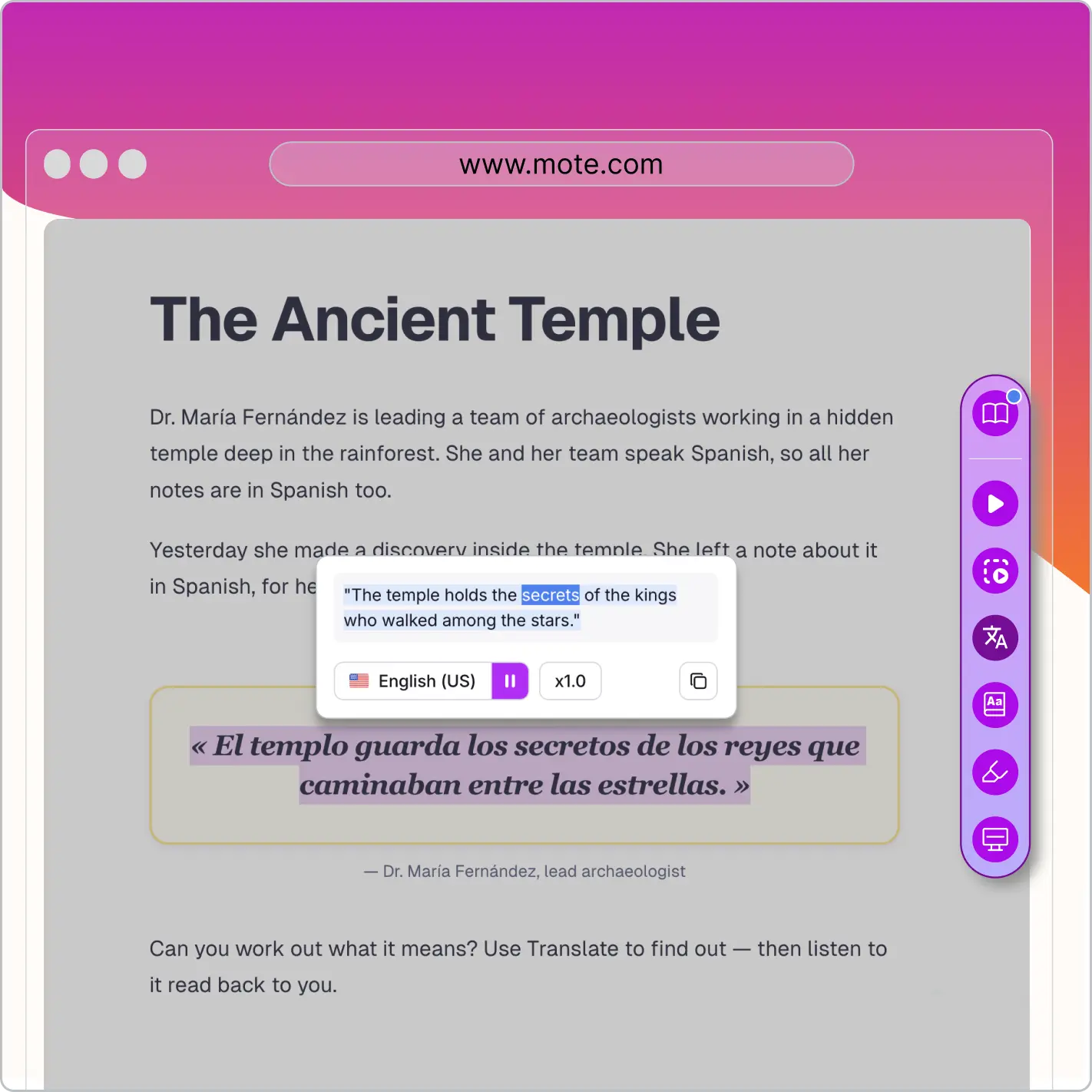
Supporting English Language Learners in Every Classroom
English language learners now make up 10.6 percent of US public school students - more than 5.3 million children, according to the National Center for Education Statistics. They are sitting in math, science, and social studies classes, learning grade-level content while still building the English they need to access it.
Mote gives teachers a practical multilingual companion that follows ELLs into any Google Doc, Slide, or web page they read. Read Aloud delivers comprehensible input. Text Prediction scaffolds writing in English. An in-context Dictionary makes academic vocabulary instantly available. Together these tools align with what reading and second-language research consistently identifies as the highest-impact ELL supports.
Mote Offers Practical Tools for English Language Learners

Read Aloud for Comprehensible Input
Mote's Read Aloud reads any selected text aloud in natural voices, with adjustable speed and dual-layer word highlighting that follows along in real time. For ELLs at WIDA Levels 1 to 3, hearing English while seeing it on the page builds the phonological-visual link that decoding alone cannot. Teachers use Read Aloud during shared reading, on assignments students take home, and as an accommodation for assessments where read-aloud is permitted.
This kind of multimodal input is what reading research calls comprehensible input - the foundation of second-language literacy development. ELLs gain access to grade-level texts they could not yet decode independently, which keeps them in the same content as classmates while their language continues to develop.

Text Prediction for Writing in English
Writing in a second language carries enormous cognitive load. Every word means a decision: spelling, grammar, word choice, and sentence shape, all at once. Mote's Text Prediction suggests next words and full phrases as students type in Docs and Slides, drawing on grade-appropriate language and the topic of what they are writing.
For an ELL drafting a science explanation or a paragraph response, predictions remove the spelling roadblock and surface academic phrasing they have heard but cannot yet retrieve unprompted. Output volume goes up, frustration goes down, and teachers see the ideas underneath rather than the spelling tangles on top.

In-Context Academic Vocabulary
Vocabulary is the single strongest predictor of reading achievement for English language learners, according to research syntheses published by the Institute of Education Sciences. Mote's Dictionary lets students click any word in any text and get an instant student-friendly definition without leaving the page or losing their place in the reading.
That continuous access matters most with academic vocabulary - the abstract, content-area terms (analyze, evaluate, photosynthesis, denominator) that ELLs encounter daily but rarely meet in conversational English. Lookups turn from interruptions into low-friction supports, and reading momentum is preserved.

Vocabulary Building and Mastery
Looking up a word once is not the same as learning it. Mote lets ELLs save unfamiliar words to a personal vocabulary list as they read, then revisit them through retrieval practice and mastery tracking. Words move from passive recognition to active use through repeated retrieval - the same mechanism research links to long-term retention.
For teachers, this turns the messy reality of every ELL needing different vocabulary into something manageable. Each student builds the list that matters to their assignments, their grade level, and their current proficiency, and the practice happens in five-minute slices rather than long worksheets.

Speech to Text for Speaking Practice
Many ELLs can express ideas orally before they can write them, but classroom routines often demand the reverse. Mote's Speech to Text lets students speak directly into Google Docs and see their words appear on the page in real time. The transcript becomes a starting point for editing, and the act of speaking gives students low-stakes practice with English pronunciation and oral fluency.
For teachers, voice typing closes the gap between what students know and what they can put on paper - a gap that can mask real understanding when written English is still developing. Students hear themselves and see their words simultaneously, which research links to gains in both speaking and writing fluency over time.
Why Supporting English Language Learners Matters in Education
According to the National Center for Education Statistics, 5.3 million students - 10.6 percent of US public school enrollment - are classified as English learners. The number grew through the 2010s and continues to climb. In 13 states and Washington DC, ELLs make up at least 10 percent of students; in New Mexico, the figure reaches 18.8 percent. Most are in elementary grades: nearly 15 percent of US kindergarteners are ELLs.
Research synthesis points to four practices with the strongest evidence base: explicit vocabulary instruction, structured English-language interaction with peers, sheltered content instruction with built-in language scaffolds, and multimodal access to grade-level texts. The federal Office of English Language Acquisition makes the same case in its January 2025 evidence brief on instructional practices for English learners.
A 2024 meta-analysis in Language Teaching Research (Li, Tong, Irby et al.) examined the effects of scaffolding, graphic organizers, interactive read-aloud, and leveled questioning on ELL reading comprehension - and found measurable gains across all four. The Mote tools above were chosen because they map directly to these evidence-based practices: read-aloud for comprehensible input, predictive text for scaffolded output, and in-context dictionary lookup for vocabulary depth.
Explore more of
English Language Learners with Mote
Teaching Reading to ELL Students: 7 Evidence-Based Strategies
ELL Accommodations: A Teacher's Guide for IEPs, 504 Plans, and Assessments
10 ELL Teaching Strategies That Actually Work in the Classroom
ESL Lesson Plans for Teachers: 4-Phase Framework + Grade-Band Templates
The 5 Stages of Language Acquisition: A Guide for Teachers
Translation Tools for ELL
Supporting ELL Students in Google Classroom
Frequently Asked Questions About English Language Learners
Common questions about supporting English language learners in K-12 classrooms.
What is the difference between ELL and ESL?
ELL stands for English Language Learner and refers to the student. ESL stands for English as a Second Language and refers to a program or class designed to teach English to non-native speakers. In US schools, ELL has largely replaced ESL because many students speak two or more languages before encountering English, making the term "second language" inaccurate. The terms are often used interchangeably in practice, but ELL is now standard in US education policy and research.
What are the most effective classroom strategies for English language learners?
The strategies with the strongest evidence base for English language learners are explicit vocabulary instruction with multiple exposures to academic words, sheltered content instruction with built-in language scaffolds, structured peer interaction, and multimodal access to grade-level texts through read-aloud, visuals, and graphic organizers. The US Department of Education NCELA brief on evidence-based practices identifies these as the practices most consistently linked to ELL achievement gains.
What accommodations should English language learners receive?
Common ELL accommodations include extended time on assignments and assessments, read-aloud of test directions or content where permitted, bilingual dictionaries, simplified written instructions, peer support arrangements, and assistive technology such as text-to-speech and speech-to-text. Federal law requires that ELLs receive supports sufficient to make grade-level content accessible, and individual states publish lists of permitted accommodations for state assessments. Many of the same supports also benefit students with reading or writing disabilities.
What is the most effective way to build academic vocabulary in ELL students?
Building academic vocabulary in English language learners is most effective when students get repeated, varied exposures to high-utility academic words across content areas. Research from the Institute of Education Sciences supports a routine of explicit instruction (definition plus example), opportunities to use the word in speaking and writing, and short retrieval practice spaced across multiple days. Tools that let students save unfamiliar words as they read, and revisit them in short practice sessions, turn vocabulary from a Friday quiz into a daily habit.
What is WIDA and how does it relate to teaching ELLs?
WIDA is a research-based framework and assessment system used by 41 US states to measure and support English language proficiency in K-12 students. It defines six proficiency levels (Entering through Reaching) across four domains: listening, speaking, reading, and writing. Teachers use WIDA levels to plan appropriate scaffolds for each ELL: students at lower levels need heavy visual and read-aloud support, while students at higher levels benefit more from academic vocabulary depth and sentence-level revision tools.
What are the 5 stages of language acquisition?
The five stages of second-language acquisition, originally described by Stephen Krashen, are pre-production (0-6 months), early production (6-12 months), speech emergence (1-3 years), intermediate fluency (3-5 years), and advanced fluency (5-10 years). Conversational fluency typically appears within two years, but academic-language fluency takes five to seven. Effective teachers match scaffolds to each stage: more visuals and read-aloud at lower stages, more peer discussion and writing at higher stages.
Last updated on
April 30, 2026
{"@context":"https://schema.org","@type":"FAQPage","mainEntity":[{"@type":"Question","name":"What is the difference between ELL and ESL?","acceptedAnswer":{"@type":"Answer","text":"ELL stands for English Language Learner and refers to the student. ESL stands for English as a Second Language and refers to a program or class designed to teach English to non-native speakers. In US schools, ELL has largely replaced ESL because many students speak two or more languages before encountering English, making the term \"second language\" inaccurate. The terms are often used interchangeably in practice, but ELL is now standard in US education policy and research."}},{"@type":"Question","name":"What are the most effective classroom strategies for English language learners?","acceptedAnswer":{"@type":"Answer","text":"The strategies with the strongest evidence base for English language learners are explicit vocabulary instruction with multiple exposures to academic words, sheltered content instruction with built-in language scaffolds, structured peer interaction, and multimodal access to grade-level texts through read-aloud, visuals, and graphic organizers. The US Department of Education NCELA brief on evidence-based practices identifies these as the practices most consistently linked to ELL achievement gains."}},{"@type":"Question","name":"What accommodations should English language learners receive?","acceptedAnswer":{"@type":"Answer","text":"Common ELL accommodations include extended time on assignments and assessments, read-aloud of test directions or content where permitted, bilingual dictionaries, simplified written instructions, peer support arrangements, and assistive technology such as text-to-speech and speech-to-text. Federal law requires that ELLs receive supports sufficient to make grade-level content accessible, and individual states publish lists of permitted accommodations for state assessments. Many of the same supports also benefit students with reading or writing disabilities."}},{"@type":"Question","name":"What is the most effective way to build academic vocabulary in ELL students?","acceptedAnswer":{"@type":"Answer","text":"Building academic vocabulary in English language learners is most effective when students get repeated, varied exposures to high-utility academic words across content areas. Research from the Institute of Education Sciences supports a routine of explicit instruction (definition plus example), opportunities to use the word in speaking and writing, and short retrieval practice spaced across multiple days. Tools that let students save unfamiliar words as they read, and revisit them in short practice sessions, turn vocabulary from a Friday quiz into a daily habit."}},{"@type":"Question","name":"What is WIDA and how does it relate to teaching ELLs?","acceptedAnswer":{"@type":"Answer","text":"WIDA is a research-based framework and assessment system used by 41 US states to measure and support English language proficiency in K-12 students. It defines six proficiency levels (Entering through Reaching) across four domains: listening, speaking, reading, and writing. Teachers use WIDA levels to plan appropriate scaffolds for each ELL: students at lower levels need heavy visual and read-aloud support, while students at higher levels benefit more from academic vocabulary depth and sentence-level revision tools."}},{"@type":"Question","name":"What are the 5 stages of language acquisition?","acceptedAnswer":{"@type":"Answer","text":"The five stages of second-language acquisition, originally described by Stephen Krashen, are pre-production (0-6 months), early production (6-12 months), speech emergence (1-3 years), intermediate fluency (3-5 years), and advanced fluency (5-10 years). Conversational fluency typically appears within two years, but academic-language fluency takes five to seven. Effective teachers match scaffolds to each stage: more visuals and read-aloud at lower stages, more peer discussion and writing at higher stages."}}]}