


ELL Accommodations: A Teacher's Guide for IEPs, 504 Plans, and Assessments
A teacher-first guide to ELL accommodations: the legal frame, the assessment supports states actually approve, and how to pick the smallest set that works.




ELL accommodations are the supports that give English learners equitable access to grade-level instruction and assessment, without changing the standard being measured. They sit alongside language instruction, not instead of it, and they are protected under Title VI of the Civil Rights Act and the Equal Educational Opportunities Act. This guide covers what counts as an accommodation, what is allowed on state assessments, and how to choose the right ones for the student in front of you.
What Are ELL Accommodations?
ELL accommodations are changes to how a student accesses content or demonstrates learning that do not change what is being assessed. A read-aloud of a math word problem is an accommodation; rewriting the question at a lower reading level is a modification. The legal frame comes from the Equal Educational Opportunities Act and a series of federal court decisions, most notably Castaneda v. Pickard, which set the three-part test for an ELL program: sound theory, adequate resources, and outcome evaluation.
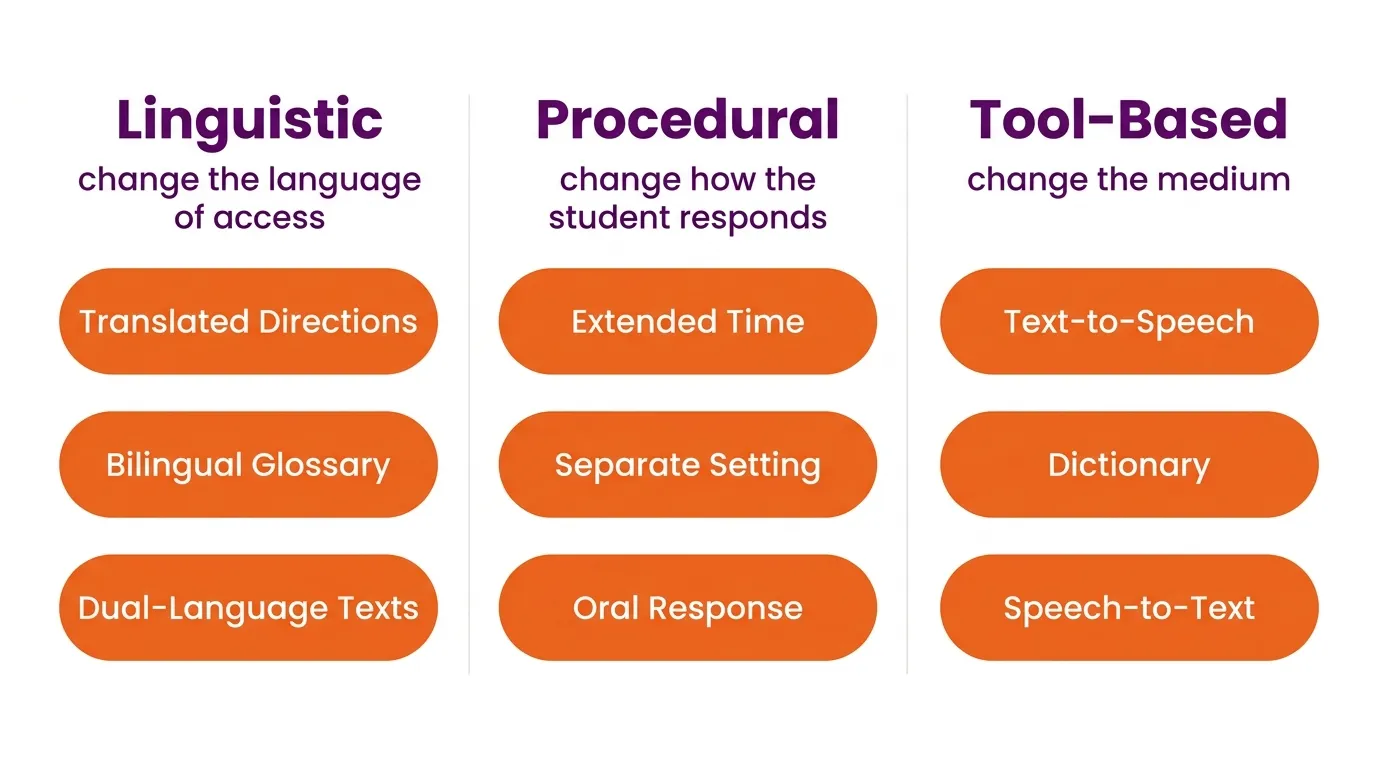
Three categories matter day to day:
- Linguistic accommodations: change the language of access (translated directions, glossaries, dual-language texts)
- Procedural accommodations: change how the student responds (extended time, separate setting, oral response)
- Tool-based accommodations: change the medium (text-to-speech, dictionary, speech-to-text)
For the underlying language model, see our 5 stages of language acquisition guide. For wider accommodation context including IEPs, the assistive technology pillar covers the assistive-tech overlap.
Federal and State Requirements for ELL Accommodations
Federal law requires that schools take affirmative steps to remove language barriers, but the specific accommodations available are set state by state. The U.S. Department of Education's NCELA tracks state policies, and the differences are real.
Three things are nearly universal across states:
- Extended time on assessments (typically 1.5x or 2x)
- English-language and bilingual glossaries on content assessments (math, science, social studies)
- Read-aloud of non-reading items (almost always allowed; rules tighten on reading-comprehension passages)
What varies most is whether translated tests are allowed, whether read-aloud applies to reading passages, and whether speech-to-text counts. Always check the current state assessment manual.
Assessment Accommodations
Assessment accommodations are the most regulated and the most consequential, because they affect the validity of the score. The accommodations below are the ones most commonly approved across U.S. states for ELLs at WIDA proficiency levels 1 to 4.
Read-Aloud Accommodations
Read-aloud of test questions and answer choices is allowed on most non-reading content tests. It is rarely allowed on reading-comprehension items because that would change what the test measures. Mote Read Aloud is district-deployable and works in the same Google Workspace where most classroom assessments live.
Extended Time and Separate Setting
ELLs typically need 1.5x or 2x time to read, process, and respond in their second language. A separate setting reduces cognitive load and is almost always allowed where time extensions are.
Glossaries and Dictionaries
Bilingual word-to-word glossaries are widely permitted. Definition-providing dictionaries are usually not. Mote Dictionary is configurable to word-only mode for assessment use.
Response Accommodations
Speech-to-text, scribe, and oral response are allowed on most tests except those measuring writing mechanics. Mote Speech to Text handles dictation inside the assessment platform where the test is delivered.
Classroom Supports That Function as Accommodations
Most accommodations that show up on a state-assessment list also belong in daily instruction, where they do their real work. The classroom is where ELLs build the language and content knowledge that the assessment will eventually measure.
- Read Aloud: daily access to dual-channel input (see and hear) on any text
- Dictionary: in-context vocabulary support without leaving the page
- Speech to Text: production scaffold so output is not gated by spelling
- Text Prediction: grade-level vocabulary surfaced as the student writes
- Vocabulary capture: Tier 2 words collected across classes for spaced revisit
For the strategy stack that wraps around these supports, see our 10 ELL teaching strategies guide.
ELL Considerations in IEPs and 504 Plans
ELL students can have an IEP or 504 plan, and many do. The legal rule, set by the U.S. Department of Education, is that a student cannot be identified for special education on the basis of limited English proficiency alone, and any IEP for an ELL must address both the disability and the language needs.
Three practical points:
- Two parallel plans: language and disability accommodations are documented separately and combined in the IEP
- Same tools, different rationale: read-aloud may be on the IEP for a learning disability and on the ELL plan for language access
- Reassessment: as English proficiency grows, language accommodations should taper. Disability accommodations follow their own evaluation cycle
Pick the Smallest Set That Works, Then Build the Routine
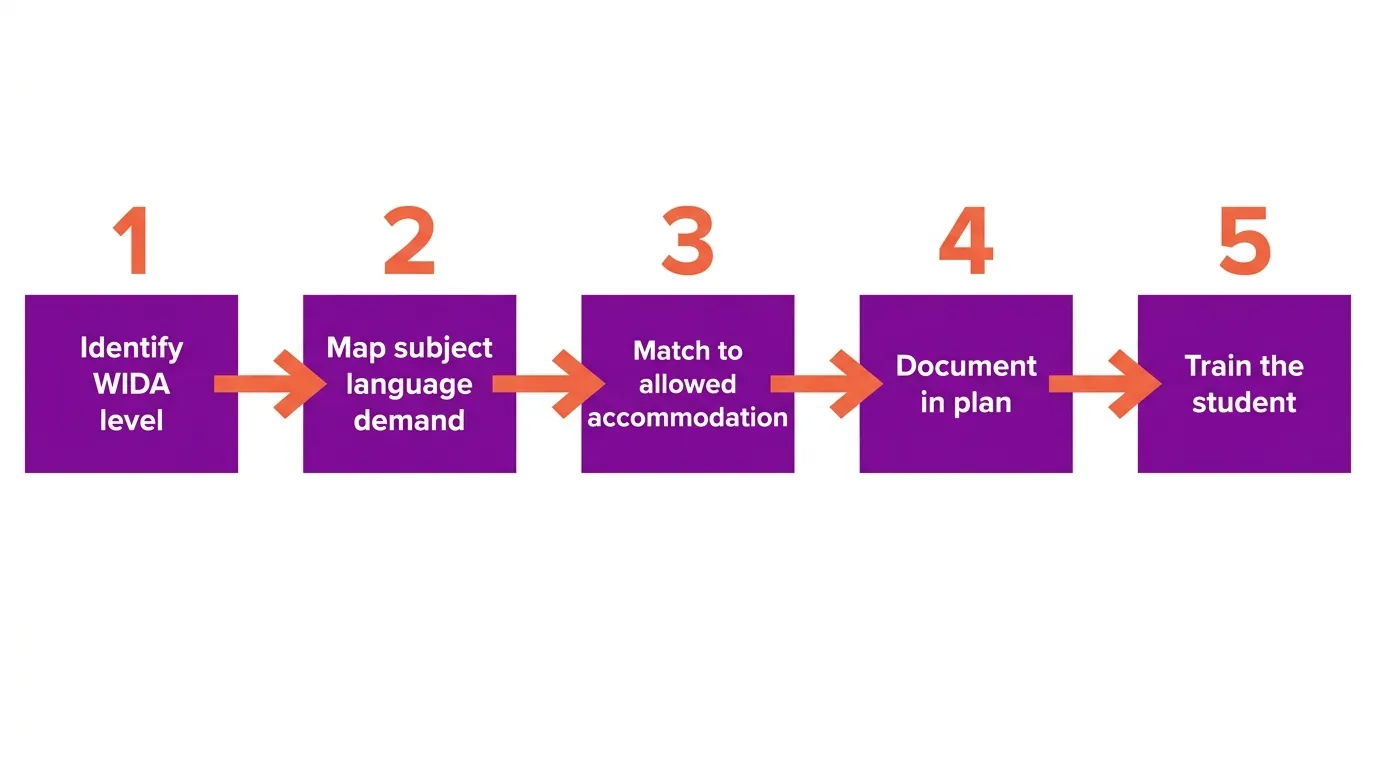
The instinct on a new ELL plan is to add every allowed accommodation. Resist it. Pick the two or three that match the student's WIDA level and actually move the work, build them into the daily routine, and let the student grow into the rest. Mote sits inside Google Workspace, so the same accommodations that a student uses on Monday in math are there on Tuesday in science. Consistency is the accommodation that compounds.