

What Is Phonemic Awareness? A Teacher's Guide
Phonemic awareness is the ability to hear and manipulate the individual sounds in spoken words. Learn the skill continuum, classroom activities, and why it matters for reading.




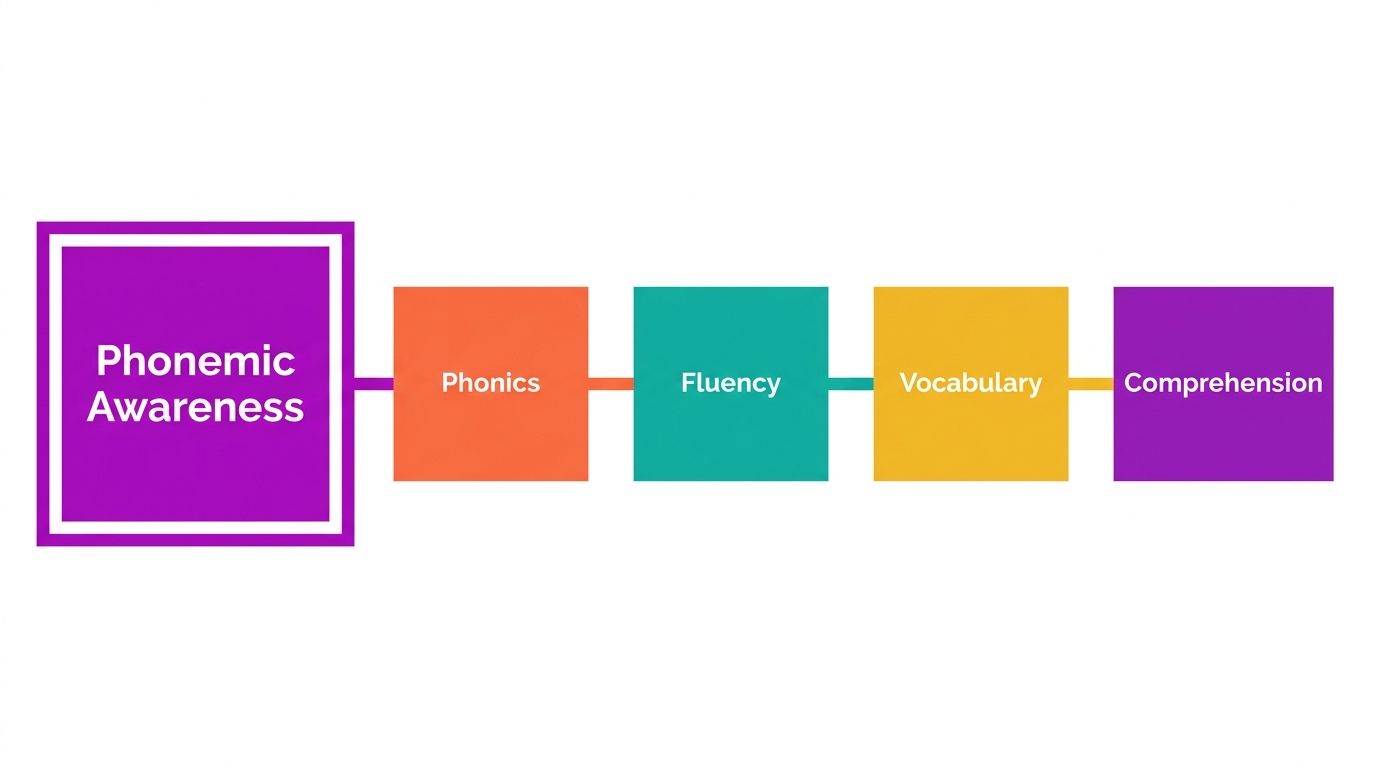
Phonemic awareness is the ability to hear, identify, and manipulate the individual sounds, or phonemes, in spoken words. It is one of the five pillars of reading identified by the National Reading Panel and a strong predictor of later reading success. This guide explains what phonemic awareness is, how it differs from related terms, and how to teach it, with practical classroom activities.
What Is Phonemic Awareness?
Phonemic awareness is the understanding that spoken words are made up of separate sounds, and the ability to work with those sounds. A student with phonemic awareness can break the word cat into its three sounds, blend sounds back into a word, and swap one sound for another. It is purely oral, with no letters required.
Because reading depends on connecting sounds to letters, phonemic awareness gives students the foundation they need before and alongside phonics instruction. It sits within the word-recognition strands described on our science of reading overview.
Phonemic Awareness vs Phonological Awareness vs Phonics
These three terms are related but distinct:
- Phonological awareness is the broad umbrella: awareness of sounds at the word, syllable, and rhyme level.
- Phonemic awareness is the narrowest, most advanced layer: working with individual phonemes.
- Phonics connects those sounds to printed letters. Phonics involves text; phonemic awareness does not.
The Phonemic Awareness Skill Continuum
Phonemic awareness develops along a continuum from simpler to more complex skills: isolation, blending, segmenting, and manipulation.
- Isolation: identifying the first, middle, or last sound in a word.
- Blending: combining separate sounds into a word.
- Segmenting: breaking a word into its sounds.
- Manipulation: adding, deleting, or substituting sounds.
Research from the National Reading Panel found phonemic awareness instruction is most effective when it focuses on one or two skills at a time and connects sounds with letters.
How to Teach Phonemic Awareness
Effective phonemic awareness instruction is explicit, brief, and frequent. Short daily sessions of five to ten minutes, taught in small groups, produce strong results. Move from oral games toward activities that connect sounds to letters as students are ready.
How Mote Supports Phonemic Awareness Practice
Mote does not replace the explicit phonemic awareness instruction a teacher provides. Instead, Mote Read Aloud lets students hear words and sentences modeled clearly, and its dictionary and vocabulary tools reinforce the words students are learning to read. Used alongside structured instruction, Mote helps developing readers stay engaged with grade-level content while their decoding skills grow.
The Bottom Line
Phonemic awareness is the gateway to decoding and one of the most reliable early predictors of reading success. Teach it explicitly, in short daily bursts, and connect sounds to letters. Tools like Mote can support practice and access, but the explicit instruction you provide is what moves students forward.