

What Is Phonics Instruction? A Guide for Teachers
Phonics instruction teaches the relationships between letters and sounds so students can decode words. Learn systematic phonics, scope and sequence, and how to teach it.




Phonics instruction teaches students the relationships between letters and the sounds they represent so they can decode written words. It is one of the five pillars of reading identified by the National Reading Panel, and it is most effective when it is explicit and systematic. This guide explains what phonics instruction is, how systematic phonics differs from incidental phonics, and how to teach it.
What Is Phonics Instruction?
Phonics instruction teaches the predictable relationships between sounds and the letters that represent them. Once students learn that letters map to sounds, they can blend those sounds to read words they have never seen before. Phonics is the link that turns spoken language into printed words and back again.
Phonics sits within the word-recognition strands of skilled reading described on our science of reading overview, alongside phonemic awareness.
Systematic vs Incidental Phonics
Systematic phonics teaches letter-sound relationships explicitly and in a planned order, while incidental phonics addresses them only as they happen to come up. The National Reading Panel found systematic phonics more effective than incidental approaches, particularly for early readers and students who struggle.
Explicit means the teacher directly teaches each relationship rather than expecting students to infer it. Systematic means the relationships are taught in a deliberate sequence that builds over time.
A Typical Phonics Scope and Sequence
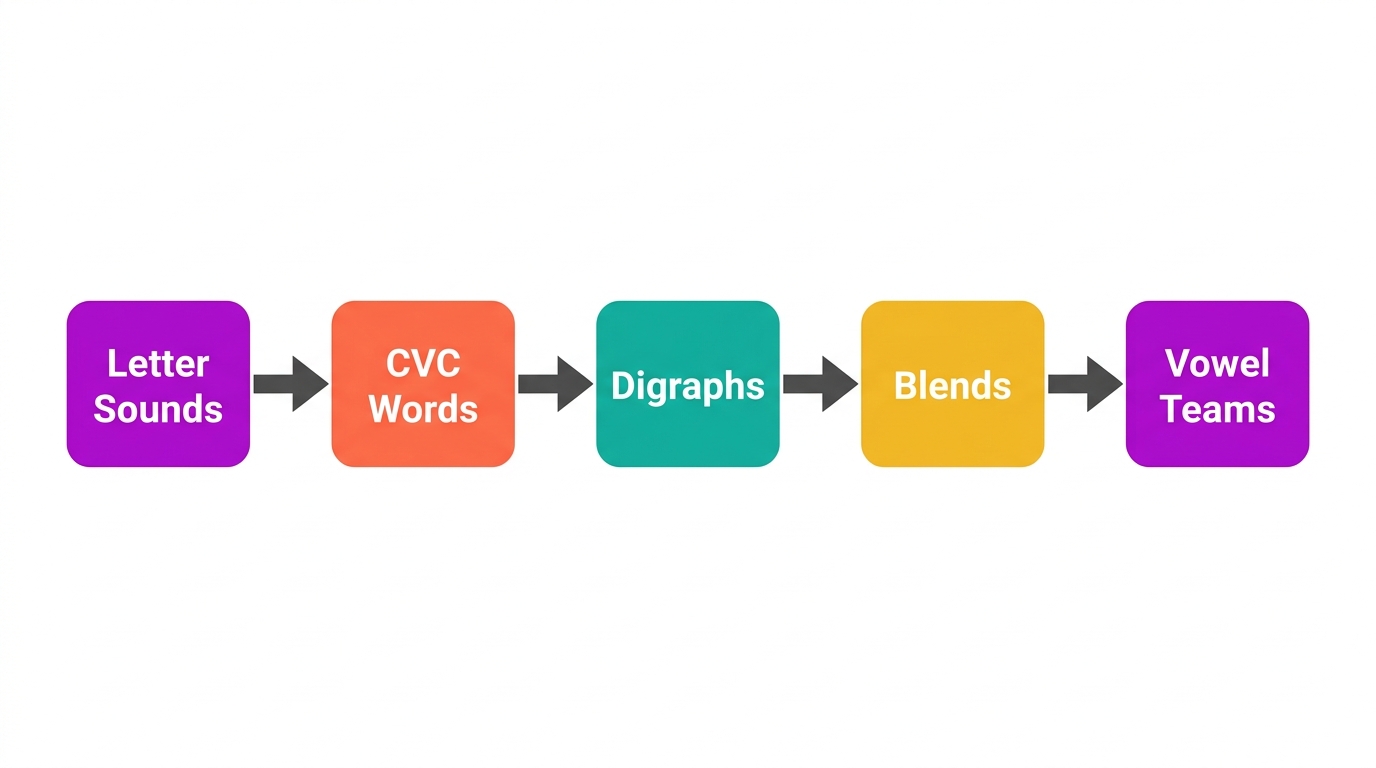
Systematic phonics follows a scope and sequence that moves from simpler to more complex patterns. A common progression looks like this:
- Letter sounds: the sounds of individual letters.
- CVC words: simple consonant-vowel-consonant words like cat and bed.
- Digraphs: two letters making one sound, such as sh and ch.
- Consonant blends: clusters like st and bl.
- Vowel teams: pairs like ea and oa.
The exact order varies by program, but the principle is the same: build deliberately from the simplest patterns to the most complex.
How Mote Supports Phonics Practice
Mote is not a phonics program, and it does not replace the explicit instruction a teacher provides. What Mote adds is access and practice: Read Aloud lets students hear words modeled accurately, and the dictionary supports word meaning once a word is decoded. Used alongside systematic phonics, Mote helps developing readers engage with grade-level text while their decoding skills grow.
The Bottom Line
Phonics instruction teaches students to connect sounds and letters so they can decode any word. Teach it explicitly and systematically, follow a deliberate scope and sequence, and pair it with phonemic awareness. Tools like Mote can support access and practice, but the explicit phonics instruction you provide is what unlocks decoding.