


Teaching Reading to ELL Students: 7 Evidence-Based Strategies
ELL reading is a parallel discipline, not a watered-down version. Here are 7 evidence-based strategies for decoding, vocabulary, and comprehension.




Teaching reading to ELL students is not a watered-down version of teaching reading. It is a parallel discipline. ELL students bring a home language, a different orthography, and often strong reading skills that need a bridge into English. The seven evidence-based strategies below cover decoding, vocabulary, and comprehension, and they are the ones that show up consistently in IES research and WIDA-aligned instruction.
What Makes Reading Hard for ELL Students?
Reading is harder for ELL students because they are decoding in a language they are still learning to speak, while also trying to comprehend grade-level content. The two demands compete for working memory. Per the U.S. Department of Education's What Works Clearinghouse, the most effective ELL reading instruction explicitly separates language work from content work and front-loads vocabulary before any reading begins.
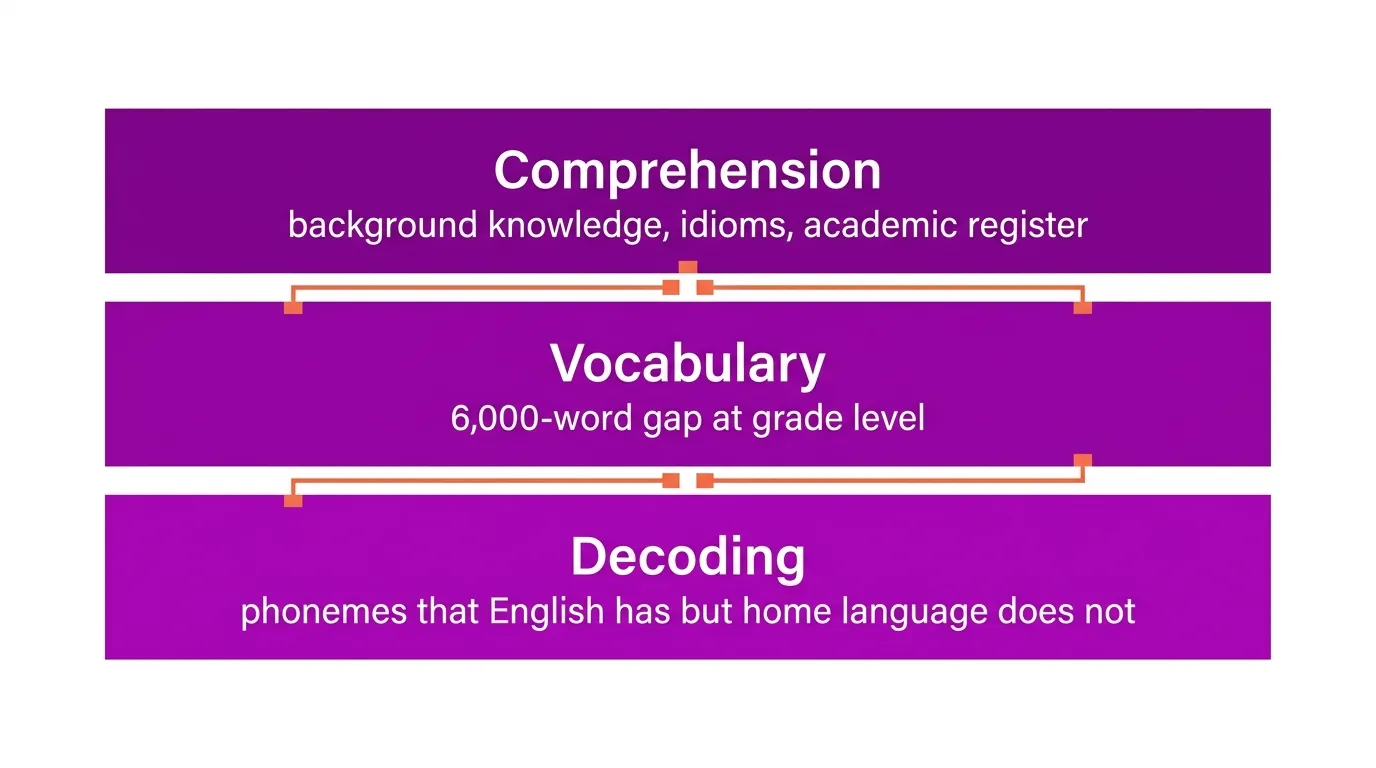
The challenges fall into three layers:
- Decoding: mapping unfamiliar phonemes onto print, with home-language interference
- Vocabulary: a 6,000-word gap between native English speakers and ELLs at grade level
- Comprehension: background knowledge, idioms, and academic register that the text assumes
For the underlying language acquisition model, see our 5 stages of language acquisition guide. For the wider TTS context, the text-to-speech pillar covers the read-aloud research base.
Strategies 1 and 2: Decoding and Phonics for ELLs
Decoding instruction for ELLs has to account for the home language. A Spanish-speaking student already knows most consonant sounds; they do not need to relearn them, they need targeted instruction on the sounds English has that Spanish does not.
1. Contrastive Phonics Instruction
Identify the phonemes that exist in English but not in the student's home language and teach those explicitly. For Spanish speakers that means short vowels, /th/, and final consonant clusters. For Mandarin speakers it means /r/, /l/, and final stops. Targeted phonics is faster than blanket phonics.
2. Read Aloud as a Decoding Bridge
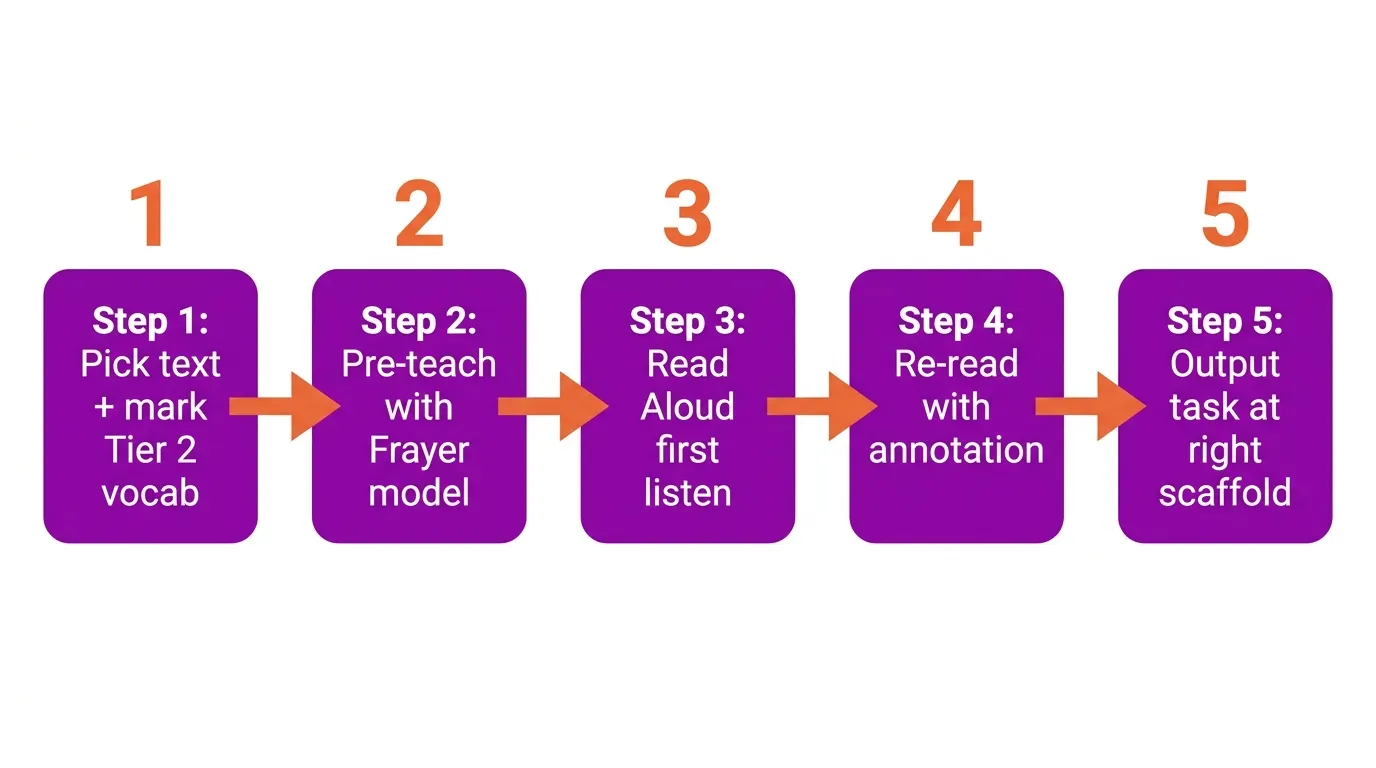
Pairing text with audio gives ELL students a phoneme-to-grapheme bridge they can replay. Mote Read Aloud reads any text in a Google Doc, Slide, or webpage at adjustable speed, so students can slow down for unfamiliar words and rebuild the sound-to-print connection on their own.
Strategies 3 and 4: Vocabulary Pre-Teaching
Vocabulary is the single highest-leverage variable in ELL reading. Students who know 95 percent of the words in a text can read it independently. Below 90 percent, the text is unreadable.
3. Pre-teach 5 to 7 Tier 2 Words Per Text
Pick the academic vocabulary the text leans on (analyse, contrast, evidence) and pre-teach with the Frayer model: definition, example, non-example, visual. Mote Vocabulary captures these words across classes for spaced revisit.
4. Use a Bilingual or Dictionary in the Moment
For words a student hits during reading, a fast dictionary lookup keeps them in the text rather than dropping out. Mote Dictionary surfaces a definition and the home-language equivalent without leaving the page.
Strategies 5 to 7: Comprehension Scaffolds
Once decoding and vocabulary are scaffolded, comprehension still needs explicit support. The strategies that work for native English readers (predict, question, summarise) work for ELLs too, but the texts and tasks need to be set up for them to succeed.
5. Text-to-Speech Alongside Silent Reading
Text-to-speech is not a replacement for reading. It is a parallel channel. ELL students who listen and read at the same time build comprehension faster than either alone, especially for grade-level content. Per the U.S. Department of Education's NCELA, dual-channel input is one of the most consistent reading-comprehension boosters in the research base.
6. Annotation With Sentence Stems
Give ELLs sentence stems for annotation: "This reminds me of...", "I do not understand...", "The author is saying...". Annotation makes thinking visible and gives the teacher a window into where comprehension is breaking down.
7. Visual Comprehension Checks
After every chunk of text, have students point to a picture, draw, or place a card on a graphic organiser. Visual checks catch comprehension failures faster than open-ended questions, and they work at every proficiency level.
How Mote Fits the ELL Reading Stack
Mote sits inside Google Workspace, so the seven strategies above show up in the same Doc, Slide, and Form the student is already using. There is no separate app, no extra login, no context switch.
- Read Aloud: dual-channel input on any text, adjustable speed, replay on demand
- Dictionary: in-context lookup with home-language support
- Vocabulary: capture Tier 2 academic words across subjects for spaced revisit
- Speech to Text and Text Prediction: low-friction output once comprehension is there
For wider planning context, see our ELL teaching pillar and the 10 ELL teaching strategies guide.
Reading Without Scaffolds Is Not Reading
The instinct with struggling ELL readers is to give them easier text. Easier text is comprehensible, but it does not build the academic reading muscles students need at grade level. The schools that close the gap fastest do the opposite: they keep the text at grade level and stack the scaffolds, then peel the scaffolds back as the student grows. Pick three or four of the seven strategies above, build them into a weekly reading routine, and let consistency do the work.






.png)
