


The 3 UDL Principles Explained (with Classroom Examples)
Engagement, representation, action and expression: a teacher-friendly breakdown of the three UDL principles and how to apply them in any lesson.




The three UDL principles are engagement, representation, and action and expression. Together, they form the Universal Design for Learning framework developed by CAST to make every lesson accessible to every student. Each principle maps onto a different brain network and answers a different question about how students learn. Roughly 15 percent of US students receive special education services, and many more are English learners or have unidentified support needs (NCES). The UDL principles give teachers a proactive way to plan for all of them.
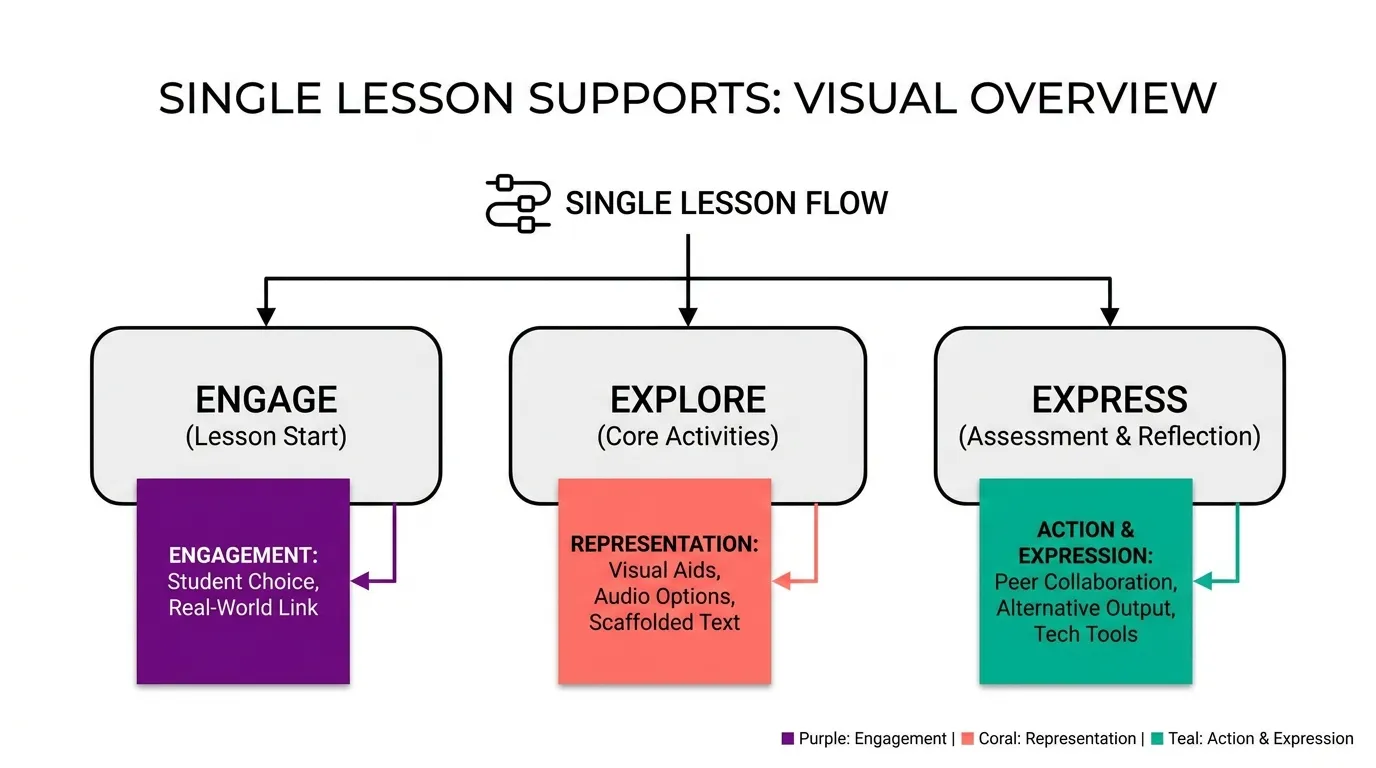
The 3 UDL Principles, in One Sentence Each
The UDL principles describe three flexible design choices teachers make before students arrive in class. Each principle increases the number of students who can access a lesson without after-the-fact accommodations.
- Engagement - the "why" of learning. Offer multiple ways to spark and sustain student motivation.
- Representation - the "what" of learning. Present information in multiple formats so every student can perceive and understand it.
- Action and Expression - the "how" of learning. Let students show their understanding in multiple ways.
Principle 1: Multiple Means of Engagement
Engagement is about why students learn. The Engagement principle asks teachers to design lessons that recruit interest, sustain effort, and support self-regulation. In neuroscience terms, this principle targets the affective network of the brain - the part that decides what matters and how hard to try.
What it looks like in practice
- Give students authentic choice in topic, format, or partner
- Connect new content to students' real interests and prior experience
- Vary the level of challenge so every learner can find their stretch zone
- Build in visible goals, timers, and progress markers so students can self-regulate
Principle 2: Multiple Means of Representation
Representation is about what students learn. The Representation principle asks teachers to present the same information through multiple modalities - text, audio, visuals, and demonstration - so the lesson does not depend on a single channel of perception.
What it looks like in practice
- Pair every reading with an audio version using text-to-speech
- Provide visual organisers (diagrams, timelines, flowcharts) alongside written text
- Pre-teach key vocabulary with an inline dictionary that supports multilingual learners
- Caption videos and offer transcripts
- Highlight patterns, big ideas, and relationships explicitly rather than expecting students to infer
Principle 3: Multiple Means of Action and Expression
Action and Expression is about how students demonstrate learning. The Action and Expression principle asks teachers to let students respond through multiple modalities - not just written essays or one-word answers.
What it looks like in practice
- Accept voice-recorded responses, written responses, or annotated diagrams against the same rubric
- Offer speech-to-text and word prediction for students who struggle with the physical act of writing
- Teach explicit strategies for goal setting, planning, and self-monitoring
- Provide scaffolds that students can fade as they build independence
How the UDL Principles Work Together
The three UDL principles are not a checklist - they are a design lens. A strong UDL lesson layers all three: engagement (offer choice in topic), representation (offer the content in two formats minimum), and action and expression (offer two ways to respond). Teachers do not need to apply all three at maximum strength in every lesson. The goal is to build flexibility into the work you already plan, so fewer students need accommodations bolted on after the fact.
The UDL principles also align with the federal Every Student Succeeds Act, which names UDL as a recommended framework for state and district instruction.
Where Mote Fits
Mote was built to put the three UDL principles directly into students' hands inside Google Workspace. Read Aloud and the Dictionary cover Representation. Voice notes and speech-to-text cover Action and Expression. Personalised pacing and choice features cover Engagement. Read our complete guide to Universal Design for Learning for the full picture.
The bottom line: the UDL principles are not a separate thing you add to your teaching. They are a smarter way to plan the teaching you already do, so more students can reach the same learning goals.