



What Is MTSS? A Complete Guide for Educators
Understand how the multi-tiered system of supports framework helps schools identify struggling students early and deliver the right level of intervention.




MTSS is a framework that schools use to identify students who are struggling and provide them with increasing levels of support. A multi-tiered system of supports organises instruction and intervention into three tiers -- universal, targeted, and intensive -- so that every student receives the help they need before falling behind. According to Panorama Education's 2023 State of MTSS report, 74% of U.S. school districts now use an MTSS framework, up from 55% in 2019.
This guide explains what MTSS is, how the three tiers work, what components make the framework effective, and how classroom technology fits into a well-implemented MTSS model.
What Is a Multi-Tiered System of Supports?
A multi-tiered system of supports (MTSS) is a proactive, data-driven framework that integrates academic instruction, behavioural support, and social-emotional learning into a single system. The Every Student Succeeds Act (ESSA) defines MTSS as a comprehensive continuum of evidence-based practices to support a rapid response to students' needs with regular observation to facilitate data-based instructional decision making.
Unlike reactive approaches that wait for students to fail before intervening, MTSS uses universal screening to identify needs early and matches each student with the appropriate level of support. The framework applies to all students -- not just those with identified disabilities -- making it a whole-school approach rather than a special education initiative.
The Three Tiers of MTSS
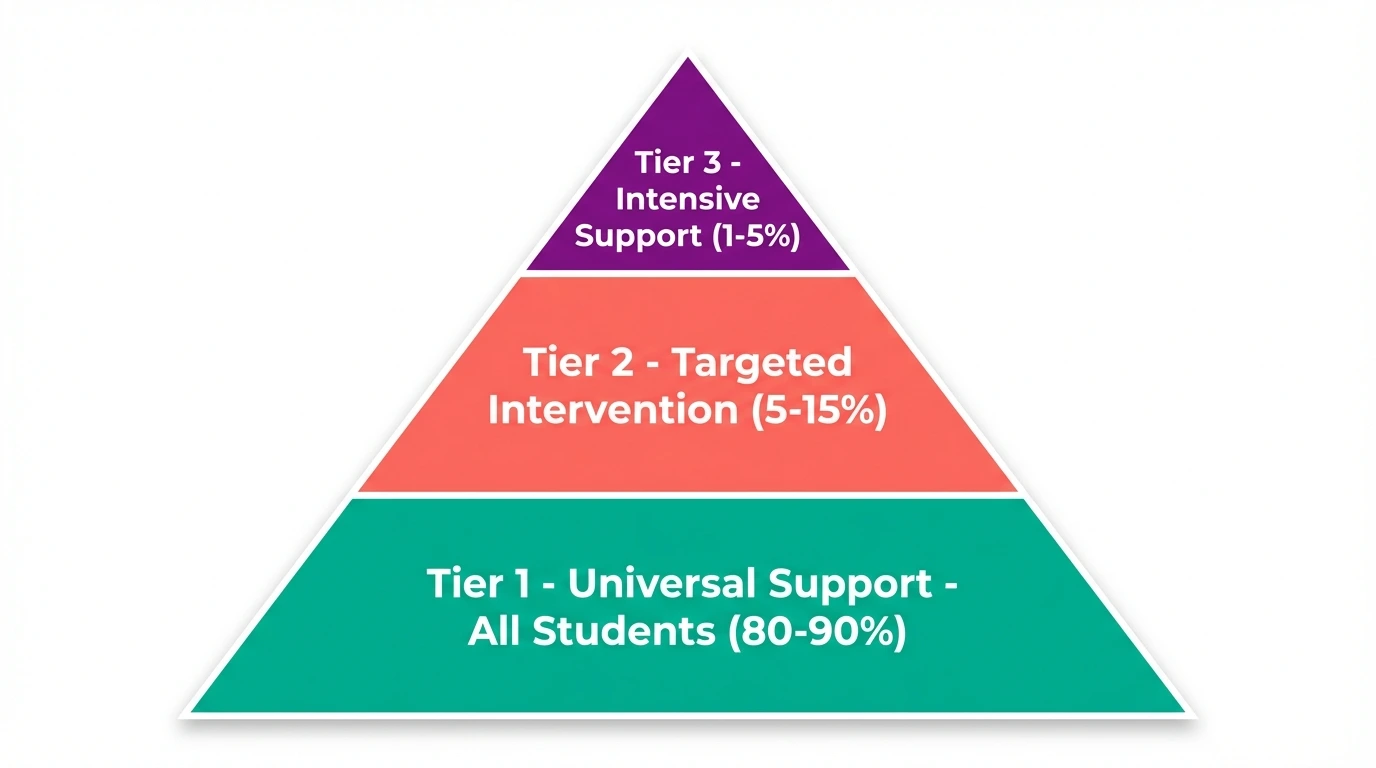
MTSS organises support into three tiers based on intensity. Tier 1 serves all students, Tier 2 targets students showing early signs of difficulty, and Tier 3 provides intensive individualised intervention for students with significant needs.
Tier 1: Universal Support
Tier 1 is high-quality core instruction delivered to every student in the general education classroom. It should meet the needs of approximately 80-90% of students. At this level, teachers use evidence-based instructional practices, differentiated teaching strategies, and universal tools like text-to-speech and screen masking that benefit all learners without requiring a referral.
Tier 2: Targeted Intervention
Tier 2 supports the 5-15% of students who need additional help beyond core instruction. These students receive targeted, small-group interventions -- typically 20-30 minutes several times per week. Examples include guided reading groups, structured vocabulary instruction, or behaviour check-in/check-out programmes. Progress monitoring happens more frequently at this level, usually every two to four weeks.
Tier 3: Intensive Support
Tier 3 serves the 1-5% of students with the most significant needs. Interventions are individualised, often one-on-one, and may involve specialists. Progress is monitored weekly. Students at Tier 3 may be evaluated for special education services, but Tier 3 support does not require an IEP -- it is part of the general education framework.
Essential Components of an MTSS Framework
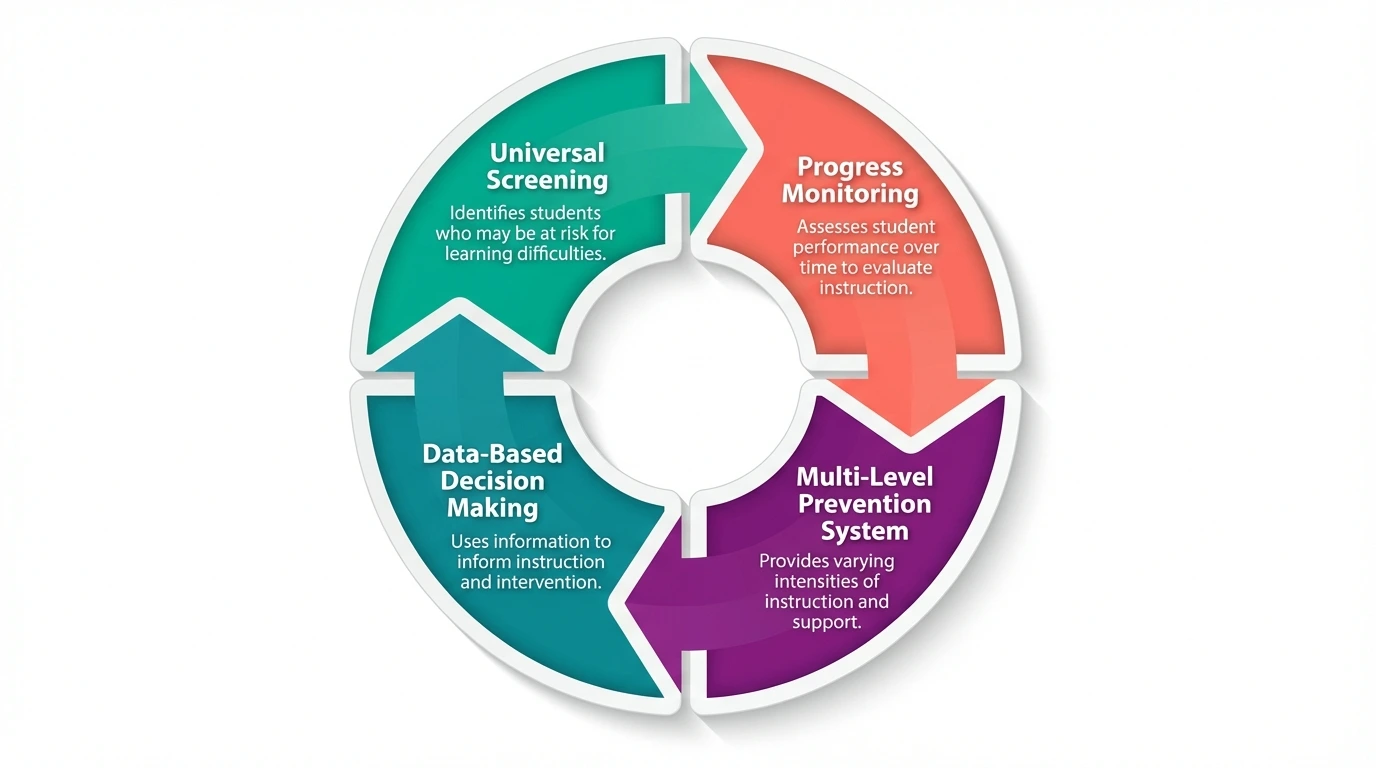
Effective MTSS implementation requires four core components working together. Without any one of these, the framework breaks down.
- Universal screening: All students are assessed two to three times per year using brief, standardised measures to identify who may need additional support.
- Progress monitoring: Students receiving Tier 2 or Tier 3 interventions are assessed regularly to determine whether the intervention is working.
- Multi-level prevention system: The three-tier structure ensures supports are matched to student needs and increase in intensity as needed.
- Data-based decision making: Teams use screening and monitoring data to decide which students need support, what interventions to use, and when to adjust or intensify.
The MTSS Center, a federally funded technical assistance centre, identifies these four components as the foundation of any effective MTSS implementation.
How MTSS Differs From RTI
MTSS and Response to Intervention (RTI) are related but not identical. RTI focuses specifically on academic interventions -- primarily reading and maths -- using a tiered model. MTSS is broader. It integrates academics, behaviour, social-emotional learning, and attendance into a single unified framework.
Think of RTI as one piece of the MTSS puzzle. A school using RTI for reading intervention is implementing part of an MTSS framework, but a complete MTSS approach also addresses behavioural supports (often through PBIS), social-emotional learning, and the systems-level infrastructure needed to coordinate all of it.
Why Schools Are Adopting MTSS
MTSS adoption has accelerated because the framework addresses several challenges schools face simultaneously. It shifts schools from a reactive model -- waiting for students to fail before providing help -- to a proactive model that catches problems early through universal screening.
Key drivers of adoption include:
- ESSA alignment: Federal funding increasingly requires evidence-based, tiered approaches to instruction and intervention.
- Early identification: Universal screening catches struggling students in weeks rather than months or years.
- Reduced referrals: Effective Tier 1 and Tier 2 supports reduce unnecessary special education referrals by addressing needs within general education.
- Whole-child focus: Integrating academics, behaviour, and SEL means schools address root causes rather than symptoms.
Supporting MTSS with Classroom Technology
Technology plays a practical role at every MTSS tier when the tools are built for classroom use. At Tier 1, universal tools like text-to-speech, text highlighting, and screen masking give all students flexible ways to access content -- aligned with Universal Design for Learning principles. At Tier 2, targeted supports like built-in translation and dictionary tools help specific groups such as English Language Learners access grade-level material. At Tier 3, intensive tools like text prediction and voice typing address individual barriers to reading and writing.
Mote brings all of these supports into a single Chrome extension that works natively inside Google Classroom and Google Workspace. With Read Aloud, Screen Mask, Highlighter, Dictionary, Translation, Text Prediction, and Speech-to-Text available from one sidebar, teachers can deliver tiered support without switching between multiple tools or pulling students out of the classroom. Deployed district-wide through Google Admin Console, Mote is FERPA, COPPA, and GDPR compliant -- trusted by over 25,000 schools.
MTSS works best when the tools supporting it are available to every student, every day, in the environment where learning already happens.




.png)