


Dyslexia vs Reading Disability: What is the Difference?
These terms overlap but are not the same. Dyslexia is a specific, neurobiological reading disability. A reading disability is the broader umbrella - and the distinction shapes evaluation, eligibility, and instruction.




The phrase "dyslexia vs reading disability" comes up constantly in IEP meetings, doctor's offices, and parent-teacher conferences, often with the assumption that the two terms mean the same thing. They overlap, but they are not identical. Dyslexia is a specific, neurobiological condition with a tight clinical definition. A reading disability is a broader umbrella that includes dyslexia and several other patterns of reading struggle. Getting the difference right matters because it shapes evaluation, eligibility, and the kind of instruction a student gets. The International Dyslexia Association and federal IDEA law use these terms in different ways, which is part of why families and even educators get confused.
What is Dyslexia?
Dyslexia is a specific learning disability (SLD) in reading, rooted in differences in how the brain processes the sound structure of language. It is neurobiological, often heritable, and lifelong. Students with dyslexia typically struggle with accurate and fluent word recognition, decoding, and spelling, despite typical intelligence and adequate instruction. For a fuller explainer, see our guide to what is dyslexia. The core hallmark is a phonological processing weakness: the brain has trouble mapping sounds to letters, which slows reading at the word level and drains energy away from comprehension.
What is a Reading Disability?
"Reading disability" is the umbrella term. It covers any persistent, significant difficulty with reading that is not explained by lack of instruction, sensory impairment, or limited English exposure. Dyslexia is the largest slice of that umbrella, but it is not the only slice. Some students decode accurately yet cannot comprehend what they read - a profile sometimes called specific comprehension deficit or "poor comprehender" pattern. Others read accurately but very slowly, with a fluency-only profile. Still others have mixed reading difficulties tied to language disorders, working memory weakness, or attention. All of these are reading disabilities. Only some are dyslexia.
Dyslexia vs Reading Disability: 5 Key Differences
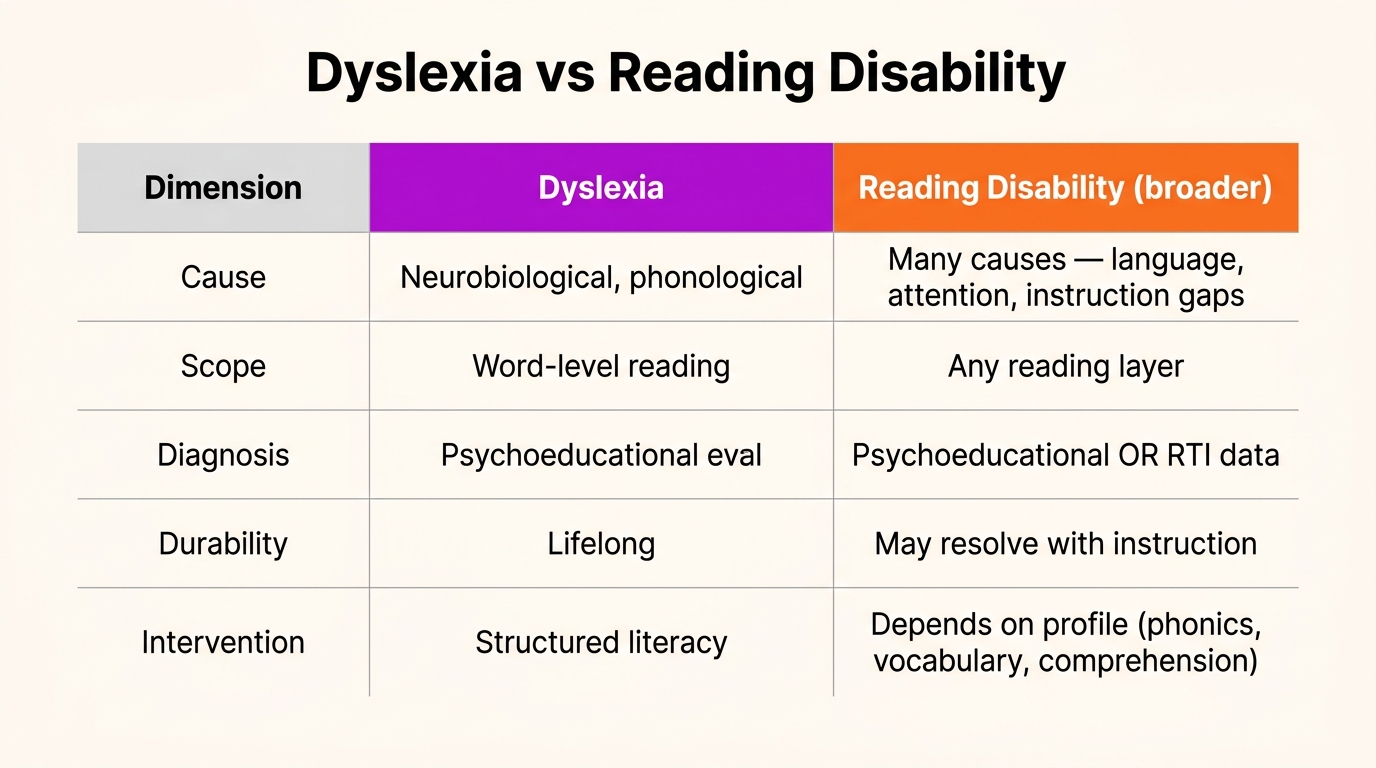
Both terms describe real struggle with reading, but they differ in cause, scope, diagnostic criteria, durability, and the intervention that works best.
1. Cause
Dyslexia has a defined neurobiological basis: phonological processing differences with strong genetic loading. A general reading disability can arise from many sources - language disorder, weak vocabulary, attention difficulties, gaps in instruction, or comprehension-specific weaknesses.
2. Scope
Dyslexia primarily affects word-level reading: decoding, accuracy, fluency, and spelling. A reading disability can sit at any layer of the reading system, from phonology up to inference and discourse comprehension.
3. Diagnostic Criteria
Dyslexia is diagnosed via a psychoeducational evaluation that documents phonological weakness alongside intact cognition. A reading disability can be identified through that same evaluation or through school-based response-to-intervention (RTI) data showing inadequate progress.
4. Lifelong vs Context-Dependent
Dyslexia is lifelong, even when students compensate well. Some reading disabilities - particularly those driven by gaps in instruction or limited language exposure - can resolve with strong teaching and time.
5. Intervention Type
Dyslexia responds best to explicit, systematic structured literacy. Other reading disabilities may need vocabulary work, comprehension strategy instruction, fluency practice, or language therapy - depending on where the breakdown sits.
Why the Distinction Matters for Schools and Parents
Naming the problem precisely changes what happens next. A student with dyslexia needs structured literacy delivered with high dosage and fidelity; piling on comprehension worksheets will not fix a phonological weakness. A student with a comprehension-specific reading disability does not need more phonics drill; they need vocabulary, background knowledge, and explicit comprehension strategy instruction. Both profiles can qualify for an IEP under the SLD category, and both can be supported through a 504 plan with accommodations like extended time and audio access to texts. The pillar guide on dyslexia in the classroom walks through eligibility and supports in more depth. For parents, the practical takeaway is to push past the label and ask: what specifically is breaking down, and what is the plan for that?
How Mote Supports Both Dyslexic and Struggling Readers
The same Mote toolset helps both groups, but the reason it helps differs. For dyslexic students, the goal is to remove the phonological barrier so cognition can move to meaning. For students with broader reading difficulty, the goal is comprehension scaffolding, vocabulary support, and relief from decoding fatigue. Read Aloud with Human-Like Voice turns any web page or Google Doc into natural audio. PDF Read Aloud and Image Text Read Aloud extend that access to worksheets, scanned textbooks, and photographed handouts. The Dictionary gives instant, in-context definitions so vocabulary gaps do not derail meaning. Highlighter keep active reading visible so students can return to key ideas without re-reading. Speech to Text separates thinking from spelling, letting both groups show what they know in writing.
The bottom line: dyslexia is a specific kind of reading disability, not a synonym for one. If a student is struggling with reading, do not stop at the label. Ask what is breaking down, evaluate accordingly, and match instruction to the specific profile - structured literacy for dyslexia, targeted comprehension or fluency work for other reading disabilities, and assistive technology for both.


.png)