



MTSS vs RTI: A Definitive Comparison for School Leaders in 2026
Same goal, different scope. Here is how MTSS and RTI overlap, where they diverge, and which framework U.S. school districts now use as the default.




If you have ever tried to explain MTSS vs RTI to a parent, a new teacher, or a school board member, you know how messy it gets. The two frameworks share DNA, share tier language, and share the same goal: catch students before they fall behind. But they are not the same thing, and in 2026, U.S. states have moved decisively to MTSS as the default model for tiered student support.
MTSS vs RTI: The 30-Second Answer
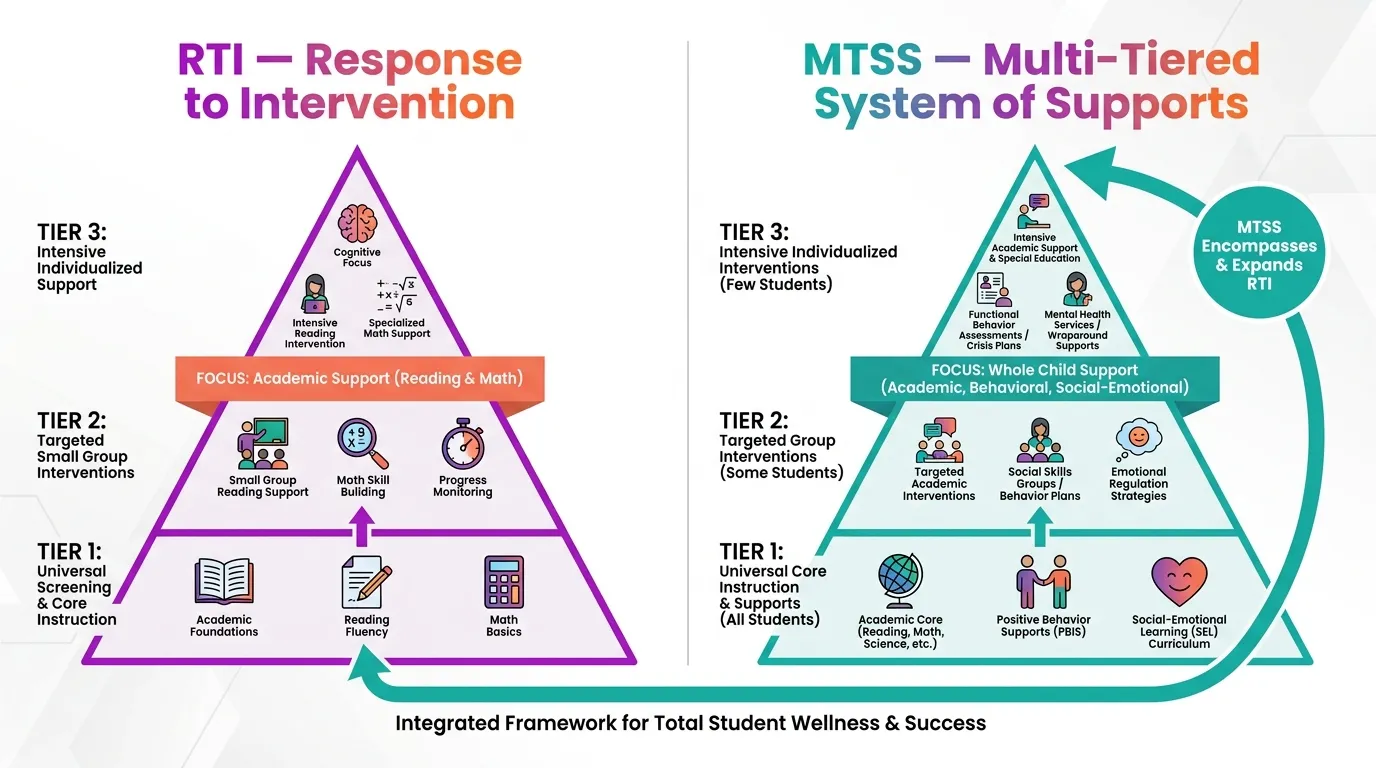
RTI (Response to Intervention) is an academic intervention framework introduced under IDEA 2004 to identify and support students struggling with reading, writing, and math. MTSS (Multi-Tiered System of Supports) is a broader framework that includes RTI's academic tiers and adds behavioral support, social-emotional learning, and whole-child intervention to the same decision-making structure. In practice, MTSS contains RTI, not the other way around.
Quick Comparison
- Scope: RTI is academic only. MTSS is academic plus behavioral plus SEL.
- Origin: RTI came from IDEA 2004. MTSS came from ESSA 2015 and state-level expansion.
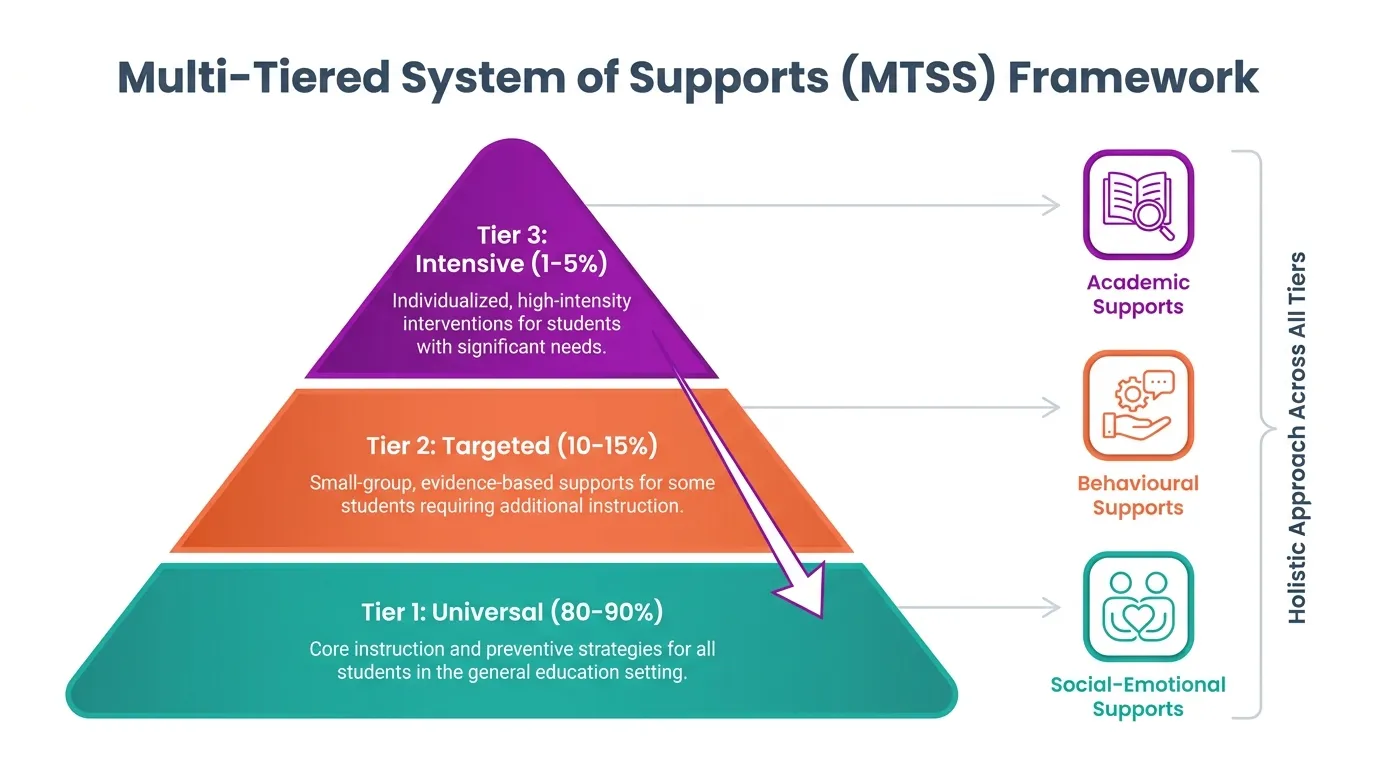
- Tiers: Both use a 3-tier model (Universal, Targeted, Intensive).
- Data: RTI uses academic screeners. MTSS adds behavioral, attendance, and SEL data.
- State adoption (2026): Roughly 74% of districts now describe their tiered model as MTSS, up from 55% in 2019.
Where RTI Came From and Why MTSS Replaced It
RTI emerged from the 2004 reauthorization of IDEA, which allowed districts to use academic response data instead of an IQ-achievement discrepancy to identify students with specific learning disabilities. It gave schools a structured way to intervene early in reading, writing, and math.
The model worked. But practitioners hit a wall: many of the students struggling academically were also struggling behaviorally, socially, or emotionally. Treating those domains as separate problems meant duplicating data systems, duplicating teams, and missing the students whose academic gaps were really attendance or anxiety gaps in disguise.
MTSS evolved as the answer. It kept RTI's tiered intervention logic and added behavioral (PBIS) and SEL data alongside academic data. By 2026, most state education agencies and the Center on MTSS at AIR use MTSS as the umbrella term. RTI lives on, but as one academic component of MTSS rather than a standalone framework.
The 5 Key Differences Between MTSS and RTI
- Scope of supports. RTI focuses on academic outcomes. MTSS integrates academic, behavioral, and social-emotional support into a single decision-making cycle.
- Data systems. RTI relies on academic screeners (reading fluency, math fact fluency). MTSS adds behavioral data (office referrals, attendance), SEL screeners, and student self-report.
- Team composition. RTI teams are typically led by interventionists and reading specialists. MTSS teams include school psychologists, counselors, behavioral specialists, and family liaisons.
- Identification path. RTI is often associated with the special education referral process. MTSS is universal: every student is screened, regardless of suspected disability.
- Whole-child philosophy. RTI says intervene when a student fails to respond academically. MTSS says intervene when any indicator (academic, behavioral, attendance) signals a student needs more support.
Where MTSS and RTI Overlap
The frameworks share the same backbone:
- Universal screening for all students
- Three tiers of increasing intervention intensity
- Evidence-based intervention selection
- Progress monitoring and data-based decision-making
- Fidelity checks on intervention delivery
If you have built strong RTI processes, you already have around 80% of an MTSS implementation. The gap is mostly in adding behavioral and SEL data streams to the same decision-making cycle that drives your academic interventions today.
Which Framework Most States Now Use
By 2026, an estimated 74% of U.S. school districts describe their tiered intervention model as MTSS, up from 55% in 2019. States including California, Florida, Michigan, and Wisconsin have formally adopted MTSS in state-level policy. A handful of states still use RTI in legislation, but their actual implementation typically includes the behavioral and SEL components that define MTSS.
For school and district leaders, the practical takeaway: if you are applying for federal grants, partnering with your state department of education, or evaluating new tools, MTSS is the language you want in your policies and procedures. For a deeper walk-through of the full framework, our MTSS pillar guide covers tier design, team roles, and tool selection in detail.
How Mote Supports Schools Running Either MTSS or RTI
Mote was built around the same tiered logic both frameworks share. Features map cleanly to each tier:
- Tier 1 (Universal): Read Aloud, Screen Mask, Highlighter, and Translation are available to every student in the classroom with no flag and no label.
- Tier 2 (Targeted): Text Prediction, Speech-to-Text, and voice feedback support small-group intervention without singling students out.
- Tier 3 (Intensive): IEP-aligned configurations, persistent custom voices, and admin-managed accommodations for students needing the highest-intensity support.
Because Mote sits inside Google Workspace and Chrome, students reach their supports without separate logins, separate tools, or separate stigma. That matters whether you call your framework MTSS or RTI, and it matters more if you are consolidating from one to the other.
One Framework Won. Stop Maintaining Both.
The honest take: MTSS is the framework. RTI is its academic component. Districts running parallel RTI team and MTSS team meetings are duplicating effort and confusing staff. Rename the documentation, consolidate the data systems, and let students benefit from a single, whole-child decision-making structure. The era of MTSS vs RTI debates was 2014. In 2026, the answer is settled, and the work is to implement the framework you already have.
.png)


.png)